

Fiber internet continues to expand nationwide, with the Fiber Broadband Association reporting that over 76 million U.S. homes now have access. Even so, many households still rely on older connections — sometimes because providers haven't reached their area yet or they're unaware of what fiber can offer.
If you're unsure how fiber‑optic internet works or what makes it the gold standard for speed and reliability, this complete guide to fiber internet will walk you through the essentials.
What Is Fiber Internet?
Fiber internet is one of the most recent innovations in internet service technology. A fiber internet service delivers broadband directly to customers via fiber-optic cables. Each home has a dedicated fiber broadband cable, unlike the shared copper telephone wires used in cable, dial-up or digital subscriber line (DSL) internet service.
A fiber-optic cable consists of three components.
- Core: A single tiny strand of pure, solid glass that allows light to travel through it unimpeded.
- Cladding: Another layer of less pure glass that surrounds the core and prevents light signals from escaping.
- Coating: A thin layer of colored rubber that protects the glass fiber from scratches.
While older cable or copper-based technologies are susceptible to bad weather and deterioration, this construction shields fiber cables from these risks.
Fiber-optic cables contain a varying number of single fiber strands, ranging from 1 to over 6,912, depending on the application. Common cable sizes include 2, 4, 6, 12, 24, 48, 72, 144 and 288 strands, with higher counts found in data centers and high-density, long-haul backbones.
Fiber-Optic Internet Explained — How Does Fiber Internet Work?
Fiber-optic cables deliver data through light pulses that travel far faster than the electronic signals that asymmetric digital subscriber line (ADSL) broadband uses.
Fiber internet service can either be part-fiber or full-fiber. A part-fiber service, or a fiber-to-the-cabinet (FTTC) service, uses fiber-optic cables to deliver data to a cabinet somewhere in your neighborhood. Copper telephone lines transmit the data from there to your home. This service is significantly faster than dial-up or DSL internet, though much slower than full-fiber because copper wires reduce speeds somewhat.
A full-fiber service, or fiber-to-the-home (FTTH) service, solely uses fiber-optic cables to transmit data between your home and the broadband exchange for maximum speeds.
Rather than a traditional modem, FTTH requires an optical network terminal (ONT) — a small box that attaches to the wall of your house. The ONT will convert light pulses from the fiber cable to electronic signals that your internet router can understand.
What Are the Benefits of Fiber Internet to the Home?
As a relatively new technology, fiber internet offers many advantages that make it more desirable than other types of internet service.
- Fast speeds: Fiber internet is the fastest internet service available today.
- Symmetrical speeds: Fiber internet provides equal upload and download speeds, unlike most other services, whose lower upload speeds can cause frustration with activities such as video calling or gaming.
- Reduced latency: A lower latency means less lag and increased reaction times, allowing for more seamless internet usage.
- Minimal congestion: Since you have a dedicated fiber line for your home, internet usage outside your private network won't slow you down.
- Location doesn't affect speeds: While some internet services may lag depending on your location, fiber delivers the same speeds no matter where you live.
- Reliable: Since congestion, weather and other factors don't interfere with fiber internet, it's stable and trustworthy.
- Enhanced data security: Fiber-optic cables resist electromagnetic interference, making them more resilient to hacking attempts.
- Future-proofed: Fiber-optic is a relatively new and scalable technology that is unlikely to become outdated in the near future.
- Energy-efficient: The light pulses used in fiber cables use energy more efficiently than the electronic signals used in copper wire internet services.
What Speeds Can You Get With Fiber Internet?
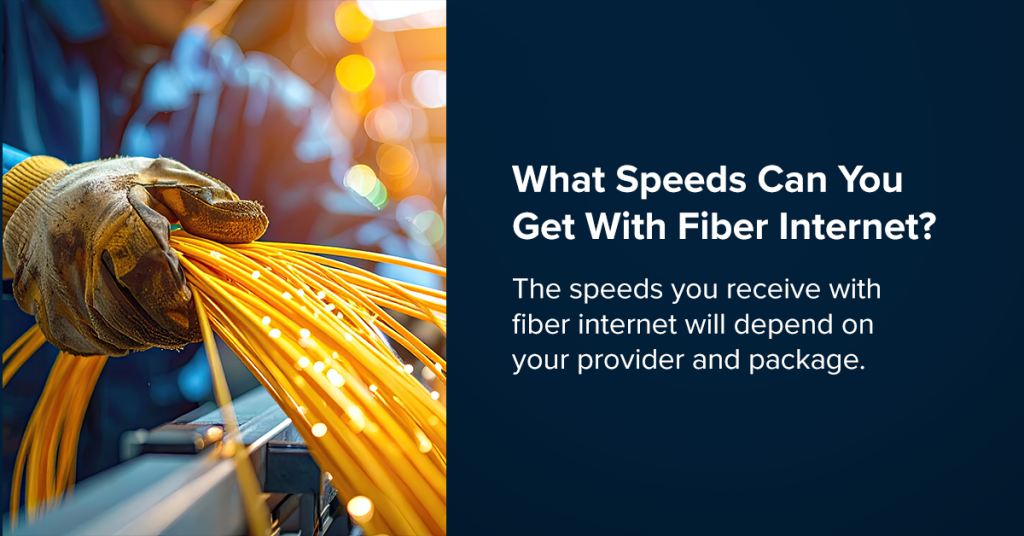
The speeds you receive with fiber internet will depend on your provider and package, but even budget-friendly agreements will provide your home with good internet speeds. A lower-tier fiber plan that meets many households' needs will achieve minimum upload and download speeds of 250 megabits per second (Mbps), though many fiber internet services deliver at least 500 Mbps.
Higher-end residential fiber internet services now regularly reach speeds of between 1 and 2 gigabits per second (Gbps), which is more than enough for most people's needs. However, if you choose premium fiber service, you may enjoy speeds up to 8 Gbps.
Is Fiber Internet Right for You?
Since fiber-optic is the best internet service on the market, it can benefit virtually any household. It delivers a fast, stable internet connection at an affordable price, providing excellent value for your money.
Fiber internet is perfect for you if you:
- Frequently do data-intensive activities, such as video streaming, online gaming and video calling.
- Live with several other people.
- Work from home and depend on a reliable connection to do your job.
- Are in a location where other types of internet service aren't suitable.
- Have a smart home system that needs a constant internet connection.
Even if you primarily use the internet for low-data activities that don't require the top speeds fiber offers, this well-engineered service can still be an asset to your household.
How to Find a Fiber Internet Provider Near You
If you decide you want the benefits of fiber internet in your home, you'll need to find a provider with a well-established presence in your community.
Your perfect fiber company will:
- Offer various packages so you can choose the one that best suits your needs.
- Provide excellent customer service to ensure you can fully enjoy your fiber internet.
- Have a stellar reputation.
- Offer a no-risk trial to see for yourself if the service is right for you.
- Have a full United States-based workforce that can deliver fast and knowledgeable support.
- Install and activate your service for free.
- Send technicians to your home without charging you for their expertise.
- Not set a data cap on your service.
Illinois and Missouri Fiber Internet Services
Fiber-optic technology is an exciting innovation in internet services. From video calling to streaming movies, gaming online to downloading files, fiber internet can reduce lag, increase speed and make work and leisure more satisfying. An expert provider can streamline every aspect of your fiber internet experience.
At i3 Broadband, we pride ourselves on our first-class customer service and reputation for excellence. With over three decades of delivering internet services in the Midwest, we've perfected our offering so you can enjoy the best internet service around.
We also understand that people may be skeptical about new technologies or unfamiliar providers, so we've introduced a no-risk trial guarantee. If you're unsatisfied with our service, you can cancel your contract within 30 days at absolutely no cost.
To find out more about our fiber internet services and how we can deliver them to your home, enter your address and explore our services in your area today.