
Choosing the right internet connection for your residence can be confusing, especially since there are multiple options on the market. There are different types of internet connections but if you've zeroed in on fiber and cable internet connections, you're on the right track. These two are the most popular wired internet solutions. While they may have similarities due to their line-type infrastructure, they have stark differences that impact how fast, reliable and consistent they are.
This guide to the differences between fiber vs. cable internet explains how each works and how they differ, helping you select the best option for your needs.
What Is Fiber Internet?
Fiber-optic internet is the most advanced internet technology, which uses strands of glass or plastic to transmit data as light over long distances almost instantly. Since fiber-optic lines transmit data in the form of light impulses, the result is a fast and reliable connection.
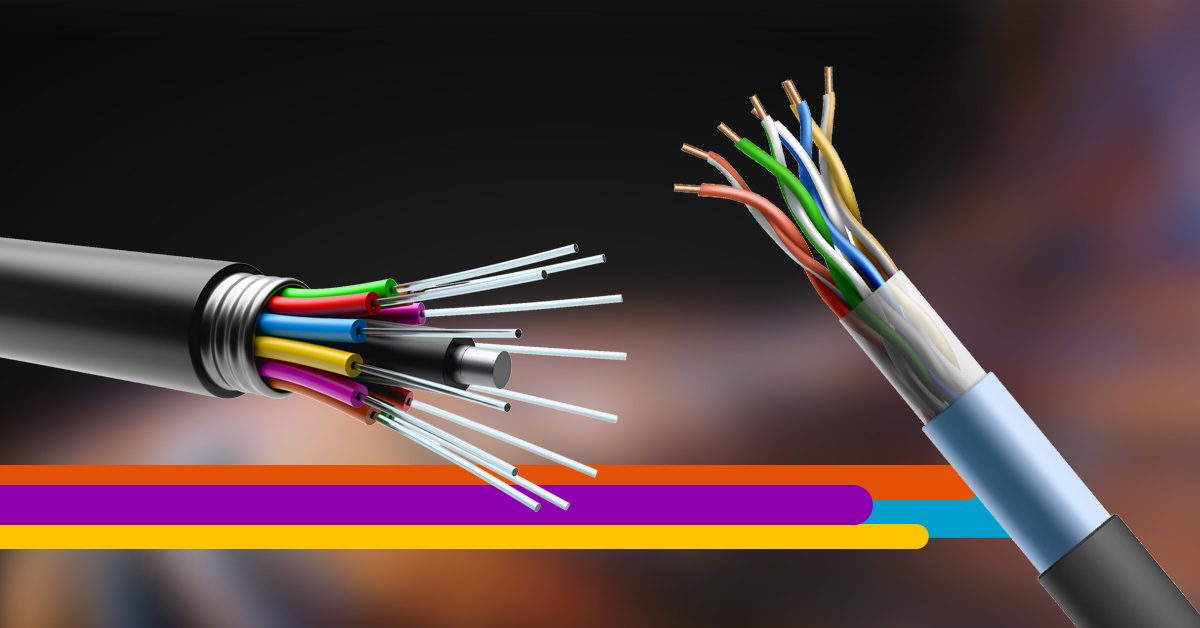
At a glance, fiber-optic lines may look similar to cable internet lines. However, they are usually thinner, lighter and more flexible, sporting a push-in plastic connector at the end for connection.
Unlike cable internet lines, which only go as far as the street or curb, fiber to the home (FTTH) is a technology that delivers internet directly to the home. That means the fiber-optic line is physically dropped into your home, enabling connection via wired or wireless equipment.
What Is Cable Internet?
The cable internet connection relies on an older technology and utilizes the same infrastructure as cable TV. It transmits internet data as electrical signals through coaxial cables, which are high-frequency electrical cables with copper wires. Your internet service provider (ISP) sends electrical signals, which carry the data to your household modem.
Since cable internet uses infrastructure that has been in place for years, it offers better availability than fiber internet, making installations and maintenance easier. You can recognize cable lines as they are thick due to their protective layer, less flexible and with metal screw-on connectors at the end.
Difference Between Fiber and Cable Internet
Your choice of internet connection will impact the performance you get and overall experience. Understanding the differences between fiber and cable internet is key to selecting a service that matches your needs.
Speed
Fiber-optic stands out from other types of internet connections for its exceptional speed. The technology transmits data as light impulses at nearly the speed of light, covering vast distances in no time. With high bandwidth and low latency, expect ludicrously-fast speeds up to 300 times faster than standard cable speeds. While ranges vary, download and upload speeds for fiber internet are symmetrical and can be as high as 8 gigabits per second (Gbps) for residential use and even higher for commercial applications.
Cable internet offers relatively fast speeds but the upload and download speeds don't match, with upload speed being far slower. In some areas, you can expect download speeds as high as 1 or 2 Gbps with an upload speed range of 5 to 50 megabits per second (Mbps). If you need to upload data-intensive files, cable internet may not be ideal for you.
For upload-heavy tasks and other intensive activities like streaming, online gaming and video conferencing, fiber internet offers the ideal speed.
Reliability
In terms of how reliable the internet connection is in the fiber vs. cable internet matchup, fiber has an edge over cable. The light transmission technology results in low latency and reduced electromagnetic interference, leading to a more stable internet connection. Also, fiber-optic lines are more resilient to environmental factors and less likely to suffer weather-related damage.
Cable internet transmits data via electrical signals, which are susceptible to outside interference, leading to a disruption in data transmission. The cable infrastructure is also sensitive to weather conditions due to the materials used in its construction. Coaxial cables are made of copper and metal shielding, which can be affected by natural fluctuations in temperature, moisture and humidity.
Performance
Fiber and cable internet differ significantly in performance due to the technologies used in transmitting data. Besides speed, the use of light in data transmission results in consistent upload and download rates, and since fiber connections are not shared, speed and performance remain stable regardless of the internet traffic. In addition, light signals maintain their strength over long distances, meaning that there's no signal degradation due to how far the connection travels.
In comparison, cable internet relies on electrical signals, which weaken over distances. While it can still be fast, the connection strength can drop during high-usage times because it's a shared network. That means the strength of your connection is dependent on the number of people in your neighborhood using the internet at that moment. The susceptibility to congestion and latency fluctuations negatively affects cable connectivity.
Long-Term Cost
There is no standard pricing for fiber internet and cable internet, as the overall cost depends on various factors, including available infrastructure, speed tiers and long-term value. You may spend more initially with a fiber connection than with cable internet, but that's typically due to the cost of deploying the infrastructure. In the long term, a fiber connection will justify its pricing due to better value in terms of performance and reliability.
Usually, cable internet is more affordable up front and may have cheaper packages because providers can afford to offer that. However, challenges such as peak-hour lags and connection disruptions may limit the value you gain from your internet service.
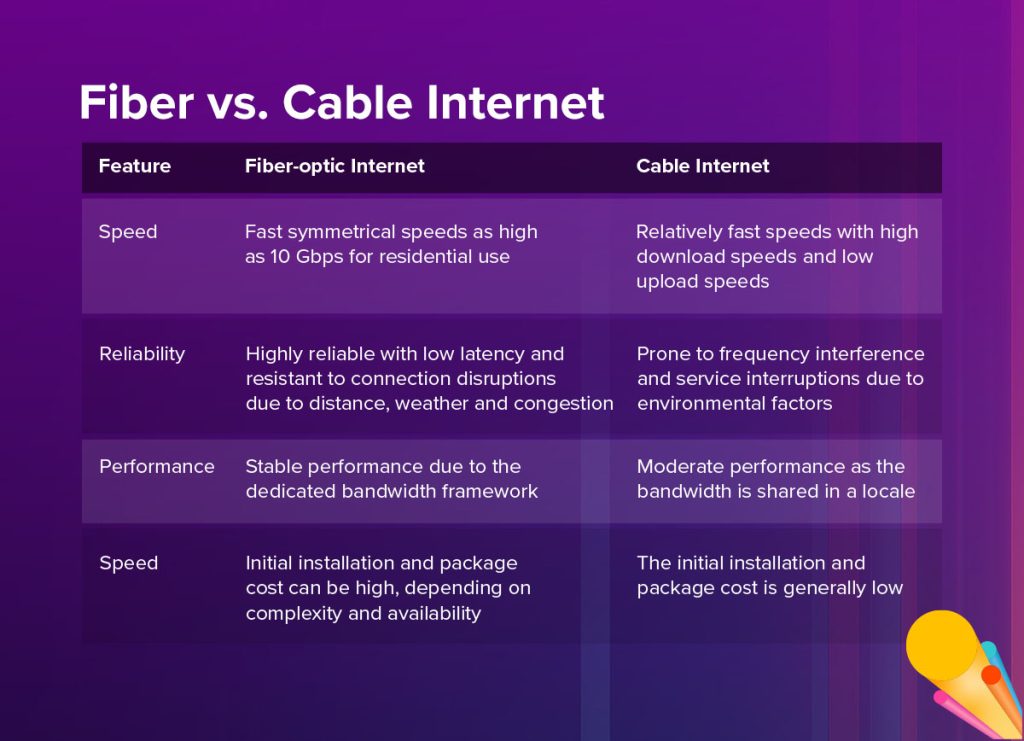
Summary Table: Fiber vs. Cable Internet
| Feature | Fiber-optic Internet | Cable Internet |
|---|---|---|
| Speed | Fast symmetrical speeds as high as 10 Gbps for residential use | Relatively fast speeds with high download speeds and low upload speeds |
| Reliability | Highly reliable with low latency and resistant to connection disruptions due to distance, weather and congestion | Prone to frequency interference and service interruptions due to environmental factors |
| Performance | Stable performance due to the dedicated bandwidth framework | Moderate performance as the bandwidth is shared in a locale |
| Cost | Initial installation and package cost can be high, depending on complexity and availability | The initial installation and package cost is generally low |
Is Fiber Internet Better Than Cable?
That depends on what you value most in an internet service. Is fiber faster than cable? Yes, and by far the fastest internet available today. Upload and download speeds are ultra-fast and symmetrical, meaning they match. That makes fiber perfect for demanding internet usage. With dedicated bandwidth and minimal interference from weather conditions and electrical signals, fiber stands out as a superior option in terms of speed and reliability.
If you value availability and a low-cost internet connection over exceptional performance, cable internet has the edge. Television infrastructure is readily available, making cable internet widely available.
Get Fast and Reliable Internet From i3 Broadband
The differences between fiber and cable internet come down to their technologies, which impact speeds, reliability, and long-term performance. Choosing between the two depends on your needs and the available options in your area. At i3 Broadband, we connect residents of Illinois and Missouri with reliable fiber internet services.
We are proud to offer the latest innovations in fiber connectivity, ensuring unparalleled service. Our i3 Smart Wi-Fi system eliminates the need for close proximity to your router, providing stable and consistent internet coverage throughout the entire home. Use our online feature to check availability. Whether you're interested in internet connection or streaming and TV, we are here for you.